How to Read Your VA Mental Health DBQ and Rating Decision Together

Key Takeaway
You finally received your Rating Decision letter, and your mental health claim was approved. But how did the VA arrive at your rating percentage, and how do you know it's correct?
Need a copy of your completed C&P exam report? See the VA's instructions for requesting it.
Your rating determines your monthly compensation and which benefits you can access, so it’s worth double-checking. One of the best ways to do that is to read your DBQ (Disability Benefits Questionnaire) and your Rating Decision letter – on their own, and side by side.
One caveat: the VA weighs all the evidence of record when evaluating your claim, not just the DBQ, so these two documents can't answer every question about your rating. Still, I've read through thousands of DBQs and Rating Decision letters, and the same handful of inconsistencies and potential errors come up again and again. They're the kind worth flagging to your VSO (Veterans Service Officer).
This article walks through five checks:
- Does the Rating Decision contradict itself?
- Is a significant DBQ symptom missing from the Rating Decision?
- Does the DBQ narrative describe a symptom the examiner didn't check?
- Does your rating differ from the impairment level on your DBQ?
- Do the DBQ's impairment level and symptoms point in the same direction?
First, a quick orientation on how VA mental health ratings work.
How the VA Mental Health Rating Formula Is Structured
The General Rating Formula for Mental Disorders (38 CFR § 4.130) governs how the VA evaluates mental health conditions (except eating disorders). It lists possible ratings of 0, 10, 30, 50, 70, and 100 percent, each paired with a written description that reads like a long list of terminology. The first time I read one, my brain checked out before I got through the second line.
It helped me to break every rating level into three pieces:
- Percentage
- Impairment description
- Symptoms
Each rating starts with a description of the overall occupational and social impairment – a general snapshot of functioning, ranging from essentially no impairment at 0% to total impairment at 100%. Starting at 30%, the formula then gives examples of symptoms that may produce that level of impairment.
At 70%, for example, the overall impairment is:
Occupational and social impairment, with deficiencies in most areas, such as work, school, family relations, judgment, thinking, or mood.
And some of the symptoms include:
Suicidal ideation
Obsessional rituals which interfere with routine activities
Speech intermittently illogical, obscure, or irrelevant
Three notes about these symptom lists:
- They're examples, not an exhaustive checklist. Other symptoms can produce the same level of impairment.
- You don't need every listed symptom to receive that rating.
- Having one of the listed symptoms doesn't guarantee that rating, either.
Keep those three pieces – percentage, impairment description, and symptoms – in mind as you read your Rating Decision letter and DBQ.
Current criteria note: The VA has proposed changes to the mental health rating criteria, but the current General Rating Formula in 38 CFR § 4.130 remains in effect as of October 11, 2026.
Where the Mental Health Rating Formula Appears in Your VA Rating Decision
When you first opened your Rating Decision letter, you probably didn’t read much past a line like this:
DECISION
Service connection for posttraumatic stress disorder (PTSD) is granted with an evaluation of 50 percent effective October 1, 2025.
Everything after that can read like dense regulatory language, but keep going. The Reasons for Decision section is where the VA actually explains itself, using the percentage, impairment description, and symptoms from the General Rating Formula.
It typically opens by restating your rating and diagnosis, then lists the symptoms the VA weighed in reaching that number. For example:
“We have assigned a 50 percent evaluation for your posttraumatic stress disorder (PTSD) based on:
depressed mood
anxiety
chronic sleep impairment
disturbances of motivation and mood
difficulty in establishing and maintaining effective work and social relationships”
Next, it explains why the next rating up wasn't warranted, naming the impairment level and symptoms associated with that higher rating:
A higher evaluation of 70 percent is not warranted unless the evidence shows occupational and social impairment, with deficiencies in most areas, such as work, school, family relations, judgment, thinking, or mood, due to such symptoms as:
suicidal ideation
obsessional rituals which interfere with routine activities
speech intermittently illogical, obscure, or irrelevant
near-continuous panic or depression affecting the ability to function independently, appropriately and effectively
impaired impulse control (such as unprovoked irritability with periods of violence)
spatial disorientation
neglect of personal appearance and hygiene
difficulty in adapting to stressful circumstances (including work or a worklike setting)
inability to establish and maintain effective relationships
In the first part, notice that although this veteran is rated at 50%:
- They don't have every symptom listed at the 50% level.
- Some of the symptoms the VA listed (depressed mood, anxiety, and chronic sleep impairment) actually belong to the 30% level.
That illustrates an important point: the VA does not simply count how many symptoms you have at each rating level. To understand where the findings in the Rating Decision came from, the next place to look is your DBQ.
Where the Rating Formula Appears on Your Mental Health DBQ
Both the Mental Disorders DBQ and the PTSD DBQ give the examiner room to describe your diagnosis, history, symptoms, and functioning in narrative form. The examiner also summarizes key findings in standardized checkbox sections, which are especially useful when you're comparing the DBQ with the Rating Formula and your Rating Decision.
Two sections are particularly useful for this comparison.
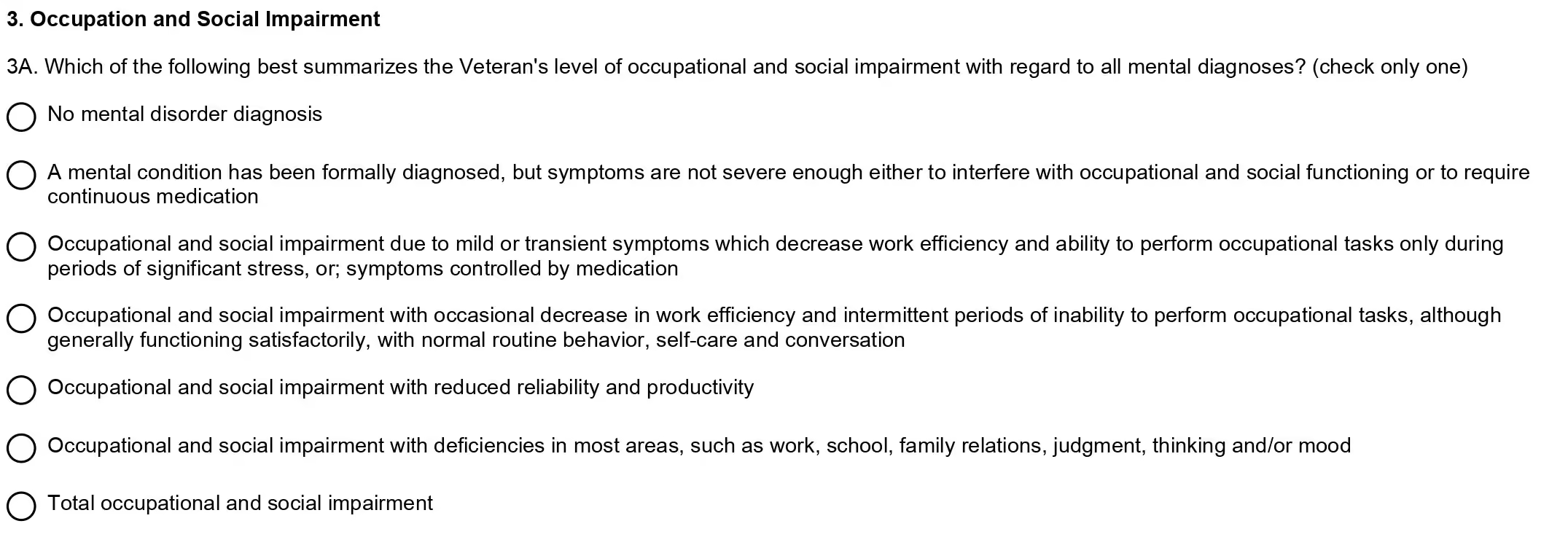
Occupational and Social Impairment. The examiner selects the description that best matches your overall level of impairment. These choices match the impairment descriptions in the General Rating Formula.
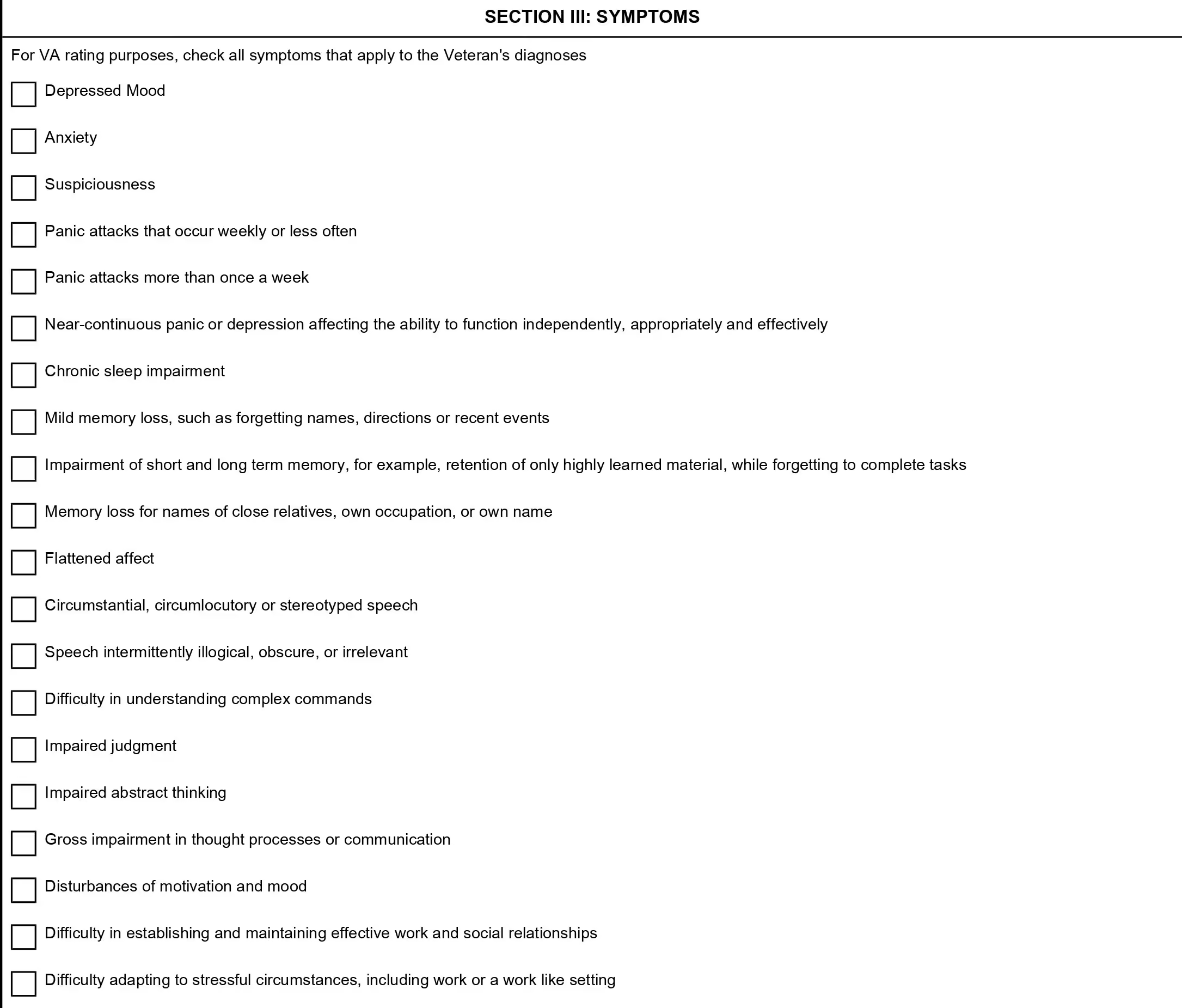
Symptoms. The examiner checks off which symptoms apply to you. They’re listed in a different order on the form, but they’re the same symptoms that appear in the General Rating Formula.
Can you tell your rating from the DBQ alone? No. The DBQ shows how the examiner summarized your symptoms and overall impairment, but the VA considers the full evidentiary record when assigning the percentage.
What the DBQ can do is give you a useful point of comparison with the Rating Decision.
How to Compare Your Mental Health DBQ With Your Rating Decision
Now that you know where the General Rating Formula shows up in both documents, here’s how to check one against the other.
1. What if the Rating Decision Seems to Contradict Itself?
Read the Reasons for Decision section closely.
I’ve seen many letters where the explanation doesn’t make sense from one paragraph to the next. A common example: the same symptom appears twice, once under the findings supporting your rating, and again in the list of symptoms that would have warranted a higher one.
For instance:
We have assigned a 50 percent evaluation for your posttraumatic stress disorder (PTSD) based on:
depressed mood
anxiety
chronic sleep impairment
disturbances of motivation and mood
inability to establish and maintain effective relationships
A higher evaluation of 70 percent is not warranted unless the evidence shows occupational and social impairment, with deficiencies in most areas, such as work, school, family relations, judgment, thinking, or mood, due to such symptoms as:
suicidal ideation
obsessional rituals which interfere with routine activities
speech intermittently illogical, obscure, or irrelevant
near-continuous panic or depression affecting the ability to function independently, appropriately and effectively
impaired impulse control (such as unprovoked irritability with periods of violence)
spatial disorientation
neglect of personal appearance and hygiene
difficulty in adapting to stressful circumstances (including work or a worklike setting)
inability to establish and maintain effective relationships
The bolded symptom appears on both lists. If the VA expressly recognized a higher-level symptom, did the decision explain why your overall symptom pattern and resulting occupational and social impairment nevertheless more closely approximated the lower rating?
2. What if a Significant DBQ Symptom Is Missing From the Rating Decision?
Are all the symptoms checked on your DBQ reflected in the Reasons for Decision section?
An omission from the symptom list doesn’t by itself prove the VA ignored the evidence or assigned the wrong rating, and not every omitted symptom is material. A missing symptom matters more when it could meaningfully change the overall disability picture, such as when the DBQ documents a symptom associated with a higher rating level.
3. What if the DBQ Narrative Describes a Symptom the Examiner Didn’t Check?
The symptoms in your Rating Decision letter may match the DBQ checklist perfectly, but was the checklist itself accurate?
Sometimes, an examiner describes a symptom in the written narrative – or in the PTSD diagnostic section – without marking the corresponding checkbox. The narrative remains part of the evidence, but those standardized checkboxes are meant to accurately summarize the examiner’s findings.
That said, a symptom shouldn’t be checked simply because the wording sounds vaguely similar. Some of the terms on the DBQ have more specific clinical meanings than they have in everyday language. But if something described elsewhere in the DBQ never makes it onto the checklist, it's worth raising with your VSO.
4. What if Your Rating Doesn't Match the DBQ's Impairment Level?
Compare the Occupational and Social Impairment level the examiner selected with the percentage the VA assigned.
These don’t have to correspond. The examiner provides an assessment, but the VA considers all the evidence when assigning a rating. Still, if your examiner selects “deficiencies in most areas” (the 70% description) and your rating is 50%, it’s fair to ask what evidence accounts for that difference.
5. What if the DBQ’s Impairment Level and Symptom Findings Don’t Seem to Match?
Compare the impairment level the examiner selected with the symptoms they checked. Do the two point in roughly the same direction?
This isn't a math problem. One symptom from a higher rating doesn't automatically put you at that impairment level, and the VA is supposed to consider the nature, frequency, severity, and duration of your symptoms and the occupational and social impairment they produce. But if the examiner selected a fairly low impairment level while checking off several symptoms from a much higher rating tier, that raises a question: how did the examiner conclude the symptoms were consistent with the lower level of impairment?
What Should You Do If Your DBQ and Rating Decision Don’t Match?
Not every difference between your DBQ and Rating Decision is an error. The examiner provides clinical findings; the VA weighs those findings along with the rest of the evidence and determines the rating.
But if you find something that deserves a second look, bring it to the attention of an accredited VSO or other VA-accredited representative. Don't wait long: you generally have one year from the date on your decision letter to request a review and preserve your potential earlier effective date.
What This Comparison Can’t Tell You
There's an important limit to this kind of review. Comparing the documents can help you decide whether the DBQ and Rating Decision make sense together. It can't tell you whether the DBQ accurately captured your symptoms and functioning in the first place. Nor can it tell you whether your rating still reflects your current level of impairment if your symptoms have gotten worse since then. If that's your situation, see How I'd Decide Whether to File for an Increase.
This article is for general education and isn't legal advice. If you're in crisis or having thoughts of suicide, call 988 and press 1, or text 838255 to reach the Veterans Crisis Line.
Frequently Asked Questions




"Everyone feels like this” isn’t always the truth.
What you think is normal may actually be a symptom that shouldn't be overlooked. This free checklist includes 25 symptoms you may have been dismissing.
Download Free Checklist
Available remotely in PSYPACT participating states: AL, AZ, AR, CO, CT, DE, DC, FL, GA, ID, IL, IN, KS, KY, ME, MD, MI, MN, MO, MS, MT, NE, NV, NH, NJ, NC, ND, OH, OK, PA, RI, SC, SD, TN, TX, UT, VA, VT, WA, WV, WI, WY.
If your state is not listed, check the current PSYPACT map to see whether it has been added.